5 Signs You've Outgrown Manual Bookkeeping Workflows
Manual bookkeeping isn't wrong — it's just a starting size, not a permanent one. Most bookkeepers keep typing in receipts and invoices by hand long after the workflow stops making sense for how much work they're actually carrying, mostly because the switch to something else feels like a bigger project than it is. Here are five signs the switch is overdue.
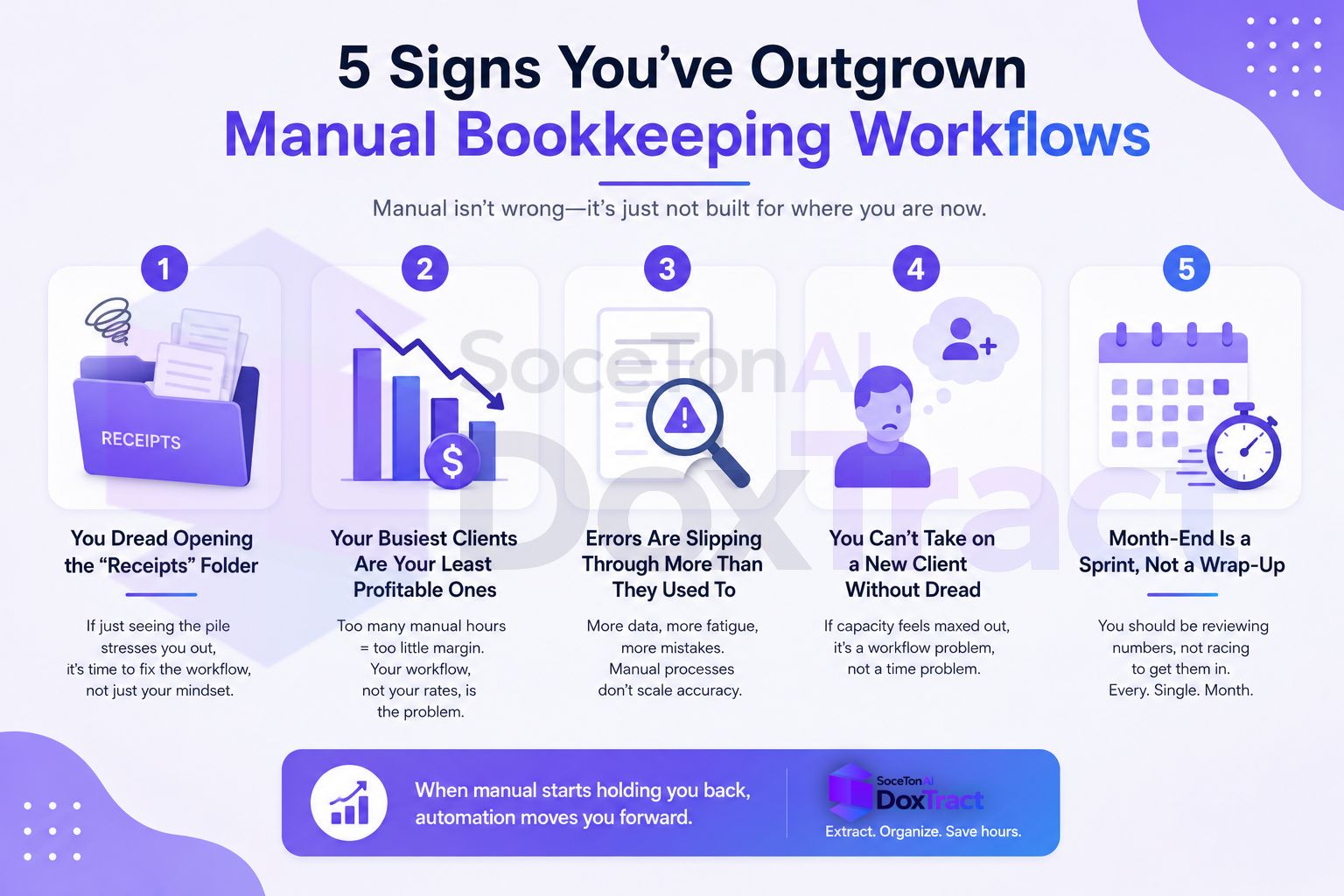
1. You Dread Opening the "Receipts" Folder
If a client's monthly document dump makes you sigh before you even open it, that's not a motivation problem — it's a volume problem. A folder that used to take twenty minutes to clear now takes two hours, and the dread is really just an accurate read on how much unpaid-feeling admin time is sitting in there.
The tell: you find yourself doing receipts in short bursts because doing them in one sitting is unbearable, rather than because the work is naturally broken into chunks.
2. Your Busiest Clients Are Your Least Profitable Ones
When you price by the client rather than by document volume, a client whose paperwork has quietly tripled is now costing you far more time than they're paying for. Manual entry scales linearly with volume — every extra receipt costs the same few minutes it always did — so growth on the client's side quietly erodes your margin on their side.
The tell: you've caught yourself thinking "I need to raise their rate" about a client whose actual bookkeeping complexity hasn't changed — just their paper volume.
3. Errors Are Slipping Through More Than They Used To
Manual data entry has a well-documented error rate, and fatigue makes it worse — the 400th receipt of the month gets less careful attention than the 4th. If you're catching more transposed totals, miscategorized expenses, or duplicate entries at review time than you used to, that's not a focus problem, it's a workload-exceeding-attention problem.
The tell: you've started double-checking your own entries as a matter of routine, because you no longer trust your first pass at volume.
4. You Can't Take on a New Client Without Dread
A healthy bookkeeping practice should be able to say yes to a good-fit new client without a gut check about capacity. If your honest reaction to a promising lead is "where would I even find the hours," your workflow — not your client roster — has become the growth ceiling.
The tell: you've turned down or quietly under-priced work recently, not because it was a bad client, but because you couldn't picture fitting the paperwork into your week.
5. Month-End Is a Sprint, Not a Wrap-Up
If closing the books each month means several days of catching up on a backlog rather than confirming numbers you've mostly already entered, data entry has become a batch crisis instead of a steady background process. That crunch compounds every tax season instead of easing with experience.
The tell: your calendar has a recurring "catch-up" block that's grown longer every quarter, not shorter.
What to Do About It
None of these signs mean you need to overhaul your entire practice at once. The fix that actually addresses all five is the same one: stop reading and typing every document by hand, and let a template read repeat-format documents automatically instead.
A practical first step:
Pick your worst-offender client — the one behind sign #1 or #2 above.
Build one extraction template for their most common receipt or invoice format in the Template Editor — no signup required to try it.
Run their next batch through it instead of typing it by hand, and time the difference yourself.
Expand client by client once you trust the accuracy, rather than converting everything at once.
This is deliberately incremental — you're not migrating your whole practice overnight, just removing the specific bottleneck that's currently costing you the most hours. Check Pricing to see what it would cost against that one client's actual document volume; the free tier (200 pages/month) is usually enough to test the whole idea before committing further.
If none of these five signs feel familiar yet, manual workflows are probably still the right fit for where you are — this is a "when," not an "always," decision.