Build vs. Buy: Should Your SaaS Build In-House OCR or Use an API?
Every SaaS team that touches documents — receipts, invoices, forms, contracts — eventually has this conversation. Someone points out that Tesseract is free, or that GPT-4o can read a document reasonably well in a quick test, and the question becomes: why pay per-page API fees when we could build this ourselves?
It's a fair question, and sometimes the answer is genuinely "build it." Most of the time, though, teams underestimate what "it" actually includes, and overestimate how differentiating the extraction layer really is for their product. Here's a realistic breakdown of both costs.
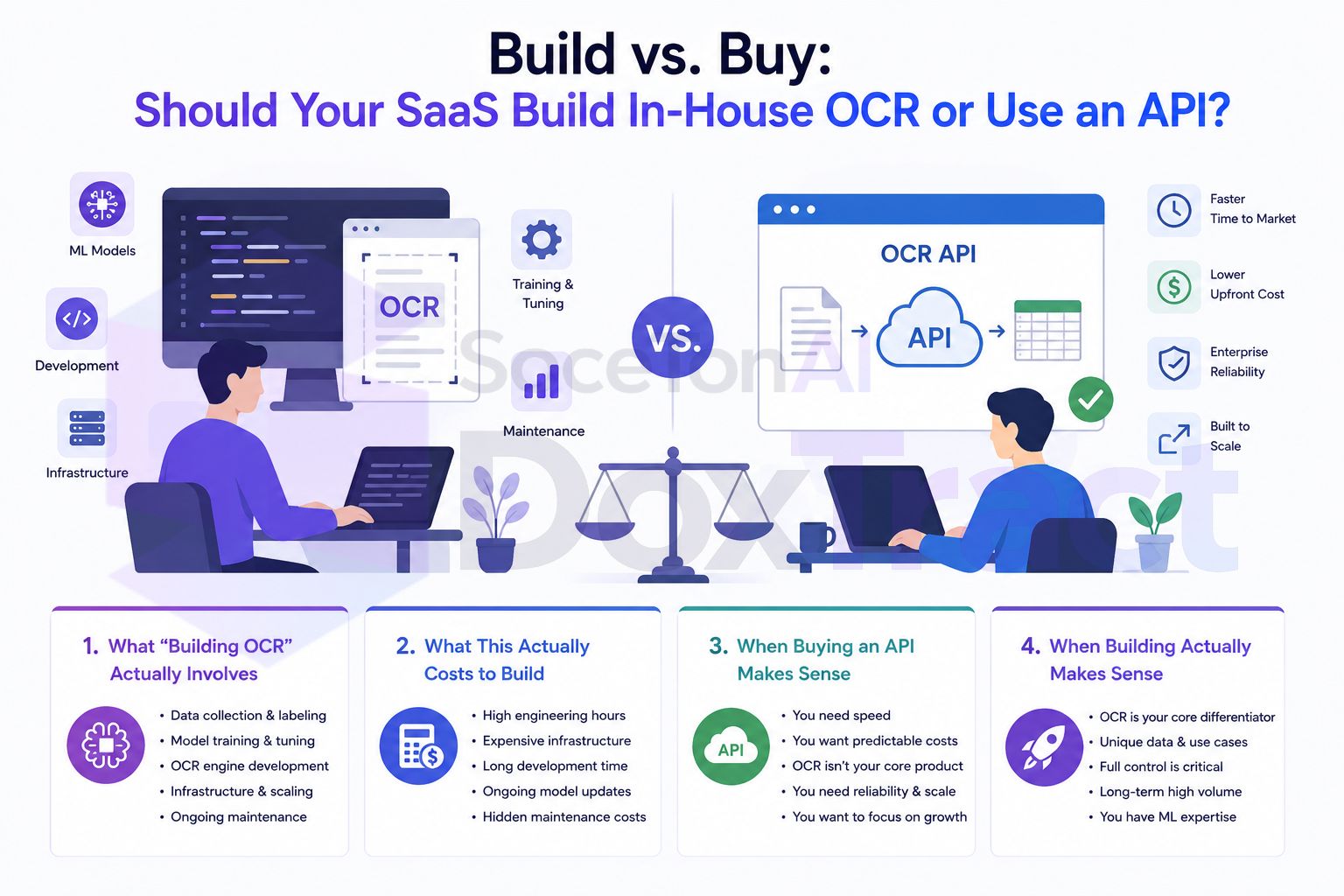
What "Building OCR" Actually Involves
The mistake most teams make is scoping "OCR" as one component. In practice, a production-grade document extraction pipeline needs several distinct pieces, and OCR — reading the raw text — is the smallest and most commoditized one:
Text recognition (OCR) — the actual pixel-to-text step, whether via Tesseract, a cloud OCR engine, or a vision model
Document classification — figuring out what kind of document this even is, before you know which fields to look for
Field/structure extraction — turning raw text into "this is the vendor, this is the total," which is where most of the real engineering work lives
Validation — catching extractions that are obviously wrong (a total that doesn't match line-item sums, a date that doesn't parse) before they reach a user
Exception handling and review tooling — a way to flag and correct the documents that don't extract cleanly, because some always won't
Monitoring and drift detection — noticing when accuracy degrades as new document formats or vendors show up
Ongoing maintenance — format changes, new edge cases, and model updates don't stop after launch
Free OCR tooling only covers the first item on this list, and it's the one that was never the hard part.
What This Actually Costs to Build
Industry cost analyses of in-house document extraction builds converge on a similar range: a production-grade pipeline covering the components above typically runs $60,000–$95,000 in first-year engineering cost for a single developer, or $120,000–$190,000 for a two-person team — and that's before ongoing maintenance, which typically adds another 20–30% of the initial build cost every year after launch, as formats change and edge cases accumulate.
Timelines tell a similar story. Comparable internal document-processing projects average six to twelve months to first production deployment, and large IT projects generally run over budget more often than not — a pattern well-documented in broader software project research, not unique to document extraction specifically.
None of this means building is a bad decision — it means it's a bigger decision than "spin up Tesseract" makes it feel like.
When Buying an API Makes Sense
For most SaaS teams, buying wins on a fairly simple argument: document extraction is usually not what your product is actually differentiated on. The parts of your product that matter to customers are almost always downstream of the extraction — what you do with the vendor, date, and amount once you have them, not the act of reading them off a PDF.
Buying an API also converts a large, uncertain upfront engineering cost into a small, predictable, usage-based one. At typical API pricing, teams processing under roughly 100,000 documents a month generally don't reach a break-even point where building would have been cheaper — the engineering and maintenance cost outweighs years of API spend at that volume. Cloud OCR/extraction APIs commonly range from under a cent to a few cents per page depending on the provider and extraction depth, which is difficult for an in-house team to beat once engineering time is honestly accounted for.
Buying also means someone else absorbs the ongoing maintenance burden — new document formats, model improvements, edge-case handling — without pulling your own engineers off product work every time a new document layout shows up.
When Building Actually Makes Sense
Building isn't never the right call. It tends to make sense when:
Volume is genuinely enormous — reliable break-even points for self-hosting generally start somewhere around 200,000+ pages a month, and even then, the maintenance burden doesn't disappear, it just gets absorbed by your own team instead of a vendor's.
Data sovereignty is a hard requirement, not a preference — some regulated industries or specific client contracts require documents to never leave infrastructure you fully control.
Extraction logic is genuinely your core IP — if the specific way you interpret a document is the product (not just a preprocessing step before your actual product), it may be worth owning end to end.
You need extraction tied inseparably into a proprietary model or workflow that no API vendor's schema could reasonably represent.
Even in these cases, a common middle path is worth considering: buy the commodity layer (OCR, format handling, basic field extraction) and build only the genuinely differentiating logic on top of it — the validation rules, business logic, and decision-making specific to your product, rather than re-solving the parts every vendor has already solved.
The Common Objection to Buying: "We Need Custom Fields for Our Document Types"
This is usually the real reason teams lean toward building — not cost, but the fear that an API will only offer a fixed set of generic fields that don't match their specific document types. That's a legitimate concern with some OCR APIs, which do ship a limited, predefined schema.
It's also the specific gap DoxTract is built to close. Instead of a fixed field list, you define a visual template per document type — drawing the exact fields and table columns you need, including layouts specific to your product's use case — and the API returns exactly that structure, not a generic approximation of it. This removes the main technical argument for building in-house without requiring you to accept a vendor's assumptions about what your documents look like. See the API docs for the full schema, or try the Template Editor directly — no signup required — to see how specific the extraction can get.
A Practical Decision Framework
Ask these questions in order — the first "yes" usually settles it:
Is document extraction your core product, or a feature inside a larger product? If it's a feature, lean buy.
Is your monthly volume under roughly 100,000 pages? If yes, buying is very likely cheaper even accounting for years of API cost.
Do you have a hard data-sovereignty requirement that no API vendor could satisfy? If yes, building (or a self-hosted option) may be necessary regardless of cost.
Does your team have spare engineering capacity for six-plus months of build time, plus ongoing maintenance indefinitely? If not, buying is the realistic option even if building looks appealing on paper.
Is the objection to buying really about cost, or about needing non-standard fields? If it's the latter, a template-based API may solve the actual problem without the build.
Getting Started
If the honest answer to the framework above points toward buying, the fastest way to evaluate fit is to test it on your actual documents rather than a generic demo. Build a template for your real document type in the Template Editor — free to try, no signup required — and compare the output against what you'd need to build yourself. Check Pricing to run the cost comparison against your own volume; the free tier (200 pages/month) is enough to validate accuracy before committing either direction.