ROI of Document Automation: How Much Time and Money Can You Save?
For a decision-maker, "invoice OCR" and "AP automation" aren't the interesting parts of this conversation — the return is. This post lays out a simple framework for estimating that return: where the savings actually come from, how to calculate a realistic number for your own volume, and what payback period to expect.
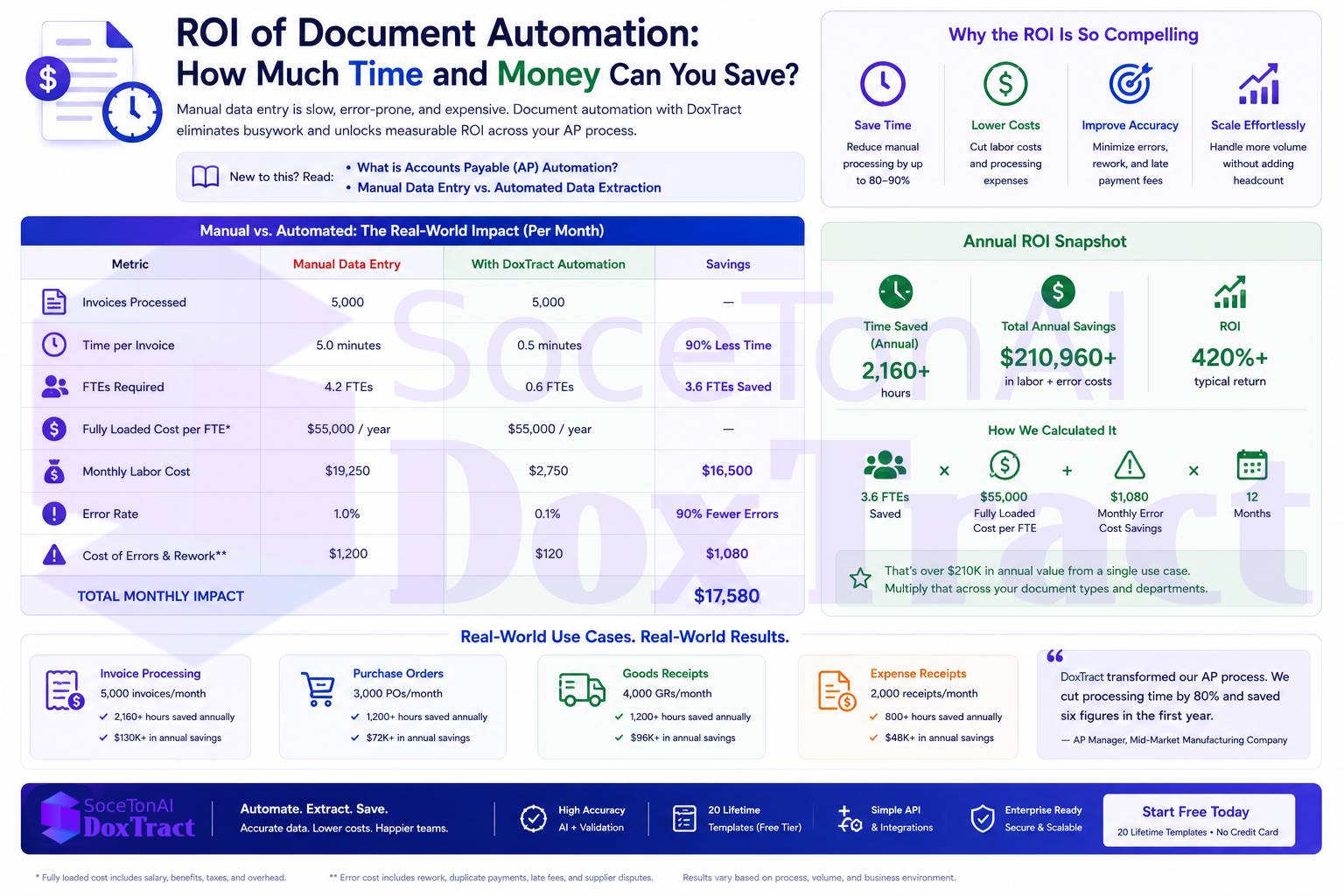
Why ROI Estimates Are Usually Either Too Vague or Too Optimistic
Most vendor ROI claims fall into one of two traps. Either they're too vague to act on ("save time and money!") or they're built on a single best-case customer story that won't generalize to your document mix, your team size, or your current process maturity.
The more useful approach is to break ROI into its actual components — each with a defensible range from independent industry data — and then apply your own numbers to each one. That's what this framework does.
The Cost Baseline: What You're Actually Spending Today
Before calculating savings, you need an honest baseline. Manual invoice processing costs $10–$22 per invoice across published industry benchmarks, with ~$16 as a commonly cited planning figure. That number isn't just data-entry time — it's the sum of five components: data entry, approval routing, matching, error correction, and exception handling. (Full cost breakdown →)
If you don't know your own per-invoice cost, a rough way to estimate it: take your AP team's fully loaded monthly cost (salary, benefits, overhead) and divide by the number of invoices they process in a month. Most teams are surprised by how close this lands to the $10–$22 industry range.
The Four Places Savings Actually Come From
1. Direct Labor Savings
This is the most obvious and most quoted category: the difference between manual data-entry time (8–15 minutes per invoice) and automated extraction plus review time (2–5 minutes per invoice). At scale, this alone typically accounts for the largest share of measurable ROI, because it's the most linear and easiest to verify against timesheets.
How to estimate it: (Current invoices/month) × (Current minutes/invoice − expected minutes/invoice) × (fully loaded hourly labor cost ÷ 60).
2. Error Reduction
Manual data entry carries a 1–5% error rate, and each error typically costs $25–$50 to research and correct — a cost most finance teams don't track as a line item because it's spread across dozens of small interruptions rather than one visible expense. Automated extraction on stable, templated layouts pushes error rates well under 1% for the fields that matter most, though it's worth being specific here rather than assuming uniform accuracy — some fields (like multi-line totals) are inherently harder to extract reliably than others, and a serious evaluation should look at field-level accuracy, not a single blended number. (How field-level accuracy actually works →)
How to estimate it: (Current invoices/month) × (current error rate − expected error rate) × (average cost per error).
3. Cycle Time and Early Payment Discounts
The median manual invoice-to-payment cycle runs around 8.3 days industry-wide; automated pipelines can bring that under a day for straight-through-processed invoices. Faster cycles unlock two financial benefits that are easy to overlook:
Early payment discounts — many vendor contracts include terms like 2/10 net 30 (a 2% discount if paid within 10 days). A slow manual cycle makes these discounts structurally unreachable; a fast automated cycle makes them realistic to capture.
Reduced late-payment risk — fewer missed due dates means fewer strained vendor relationships and less exposure to late fees.
How to estimate it: If a meaningful share of your vendor contracts include early-payment terms, multiply your eligible spend by the discount percentage and by the share of invoices you'd realistically process fast enough to qualify.
4. Scalability Without Headcount Growth
Manual invoice processing costs scale linearly with volume — doubling invoice volume typically means adding AP headcount. Automated processing scales primarily with infrastructure and review time, which grows far more slowly than a 1:1 labor curve. This is the category decision-makers most often underweight, because it doesn't show up as an immediate cash saving — it shows up as avoided future hiring as the business grows.
How to estimate it: Project your invoice volume 12–24 months out. Estimate the additional headcount manual processing would require at that volume, and compare that fully loaded cost against the incremental cost of higher-volume automated processing (which, for a platform like DoxTract, drops per-page as volume increases rather than requiring proportional new spend).
A Worked Example (Illustrative, Not a Quote)
To make this concrete, here's how the framework applies at a mid-size volume — treat the numbers as illustrative starting points to replace with your own, not a guaranteed outcome:
Assumptions: 2,000 invoices/month, current cost of $16/invoice, current error rate of 2%, current cycle time of 8 days.
| Savings category | Rough monthly impact |
|---|---|
| Labor (data entry time reduction) | Largest single line item — driven by minutes saved × invoice volume × labor rate |
| Error reduction | (2,000 × 2%) fewer errors × ~$35 average cost to fix ≈ meaningful recurring savings |
| Early payment discounts captured | Depends entirely on your vendor contract terms — worth auditing before assuming this line applies |
| Avoided future headcount | Grows the longer your volume trend continues upward |
The exact dollar total depends on your labor rates, error rate, and vendor terms — which is exactly why a credible ROI estimate has to start from your own numbers, not a vendor's average customer.
Estimating Payback Period
Once you have a monthly savings estimate from the categories above, compare it against your automation cost at the same volume. DoxTract's pricing runs as low as $0.6–$7 per 1,000 pages depending on plan and volume — at almost any invoice volume where manual cost sits in the $10–$22/invoice range, the automation cost is a small fraction of the labor savings alone, which is why most teams see payback within the first billing cycle rather than needing a multi-quarter business case.
A useful gut-check: if your current per-invoice cost is above $10, your cycle time exceeds 5 days, or exceptions consume more than 20% of your AP team's time, the labor and error-reduction categories alone are usually enough to justify automation — the cycle-time and scalability categories are upside on top of that baseline.
What to Do Before You Commit
Run this framework against your own numbers before evaluating vendors — it'll tell you which savings category matters most for your business (some teams are labor-bound, others are more exposed on error correction or missed discounts), which should shape what you prioritize in a platform evaluation. Then test the actual extraction accuracy on your own documents rather than trusting a vendor's headline number — the ROI estimate above is only as good as the accuracy assumption underneath it.
Try DoxTract free — 200 pages a month, no credit card required — to get a real accuracy and cost baseline on your own invoices before building your business case.