Rule-Based vs AI-Based (LLM) Document Extraction: Which Should You Use?
Ask five vendors how they extract data from documents and you'll get two very different answers. Some point to structured data extraction rules — fixed zones, templates, regex patterns. Others point to an LLM — send the page in, get JSON out, no configuration required. Both are legitimate approaches, and both fail in predictable, opposite ways.
This post breaks down how rule-based and AI/LLM-based extraction actually differ, where each one wins, and why DoxTract deliberately sits between them instead of picking a side.
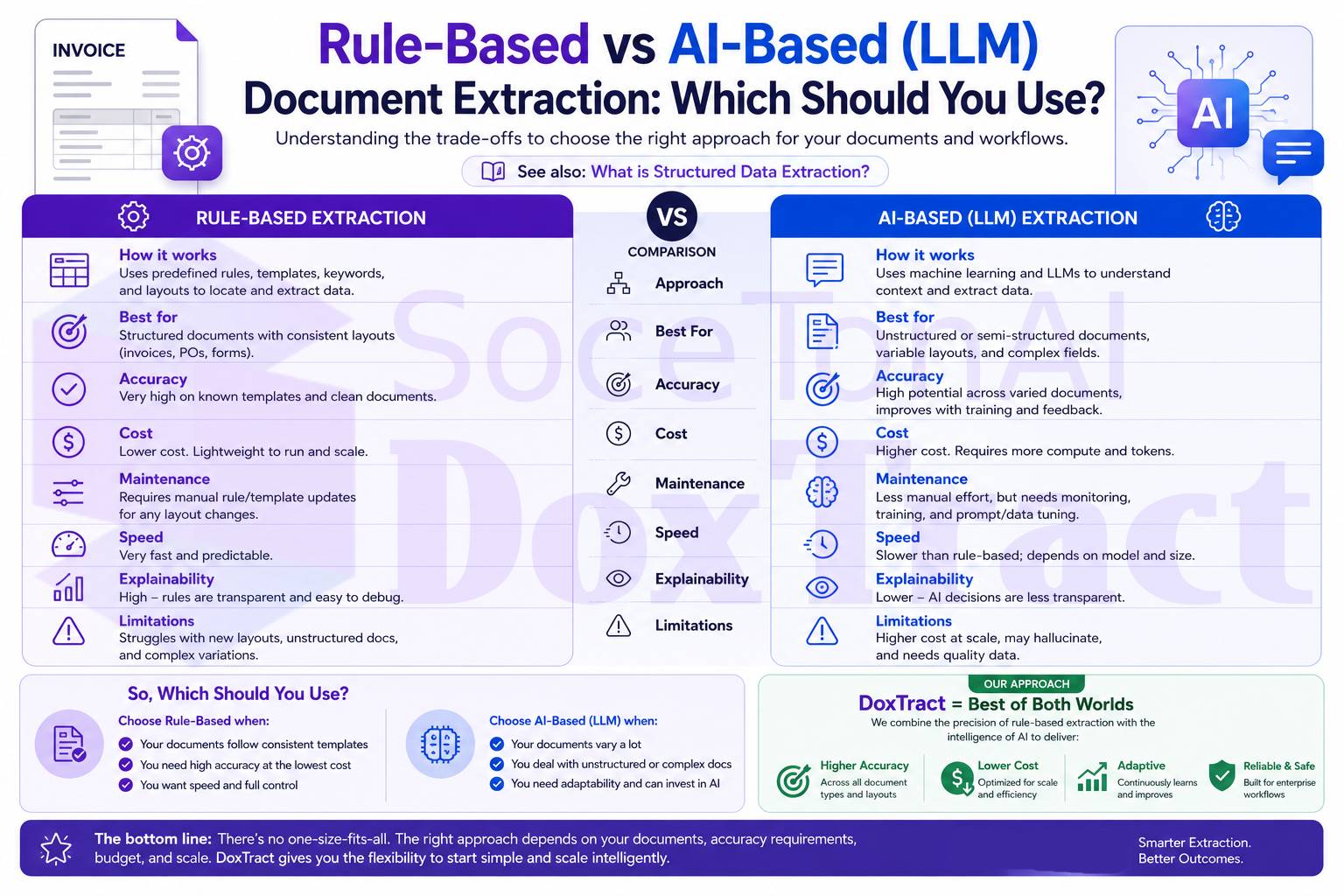
Rule-Based Extraction: How It Works
Rule-based extraction — template matching, zonal OCR, regex-driven field capture — works by defining exactly where and how to find each field ahead of time. You (or the software) draw a box around "Invoice Number," another around "Total," and the system reads whatever text falls inside those coordinates, or matches a defined pattern.
Strengths:
Deterministic. A correctly configured template either extracts the field or it doesn't — no hallucination, no guessing what the model "thinks" a total should be.
Cheap and fast. No per-token billing, no model inference cost, no GPU time. Pricing scales with pages processed, not reasoning complexity.
Fully controllable. You can explicitly exclude sensitive fields (skip a Social Security Number box on a W-9, for example) — something far harder to guarantee with an LLM reading the whole page.
Strong on multilingual and industry-specific documents. Rule-based systems don't depend on a model's training distribution, so they hold up better on documents in less-common languages or with domain-specific coded fields that general-purpose LLMs weren't trained heavily on.
Weaknesses:
Breaks on layout drift. A template built for one vendor's invoice format won't work on a different vendor's layout without a new template.
Setup cost per template. Every new document format needs to be mapped before the system can extract from it.
AI/LLM-Based Extraction: How It Works
LLM-based extraction skips the template entirely. You describe what you want in plain language — "extract the vendor name, invoice number, and total" — and a multimodal model reads the page as an image or text and returns structured output, regardless of layout.
Strengths:
No template required. New vendor, new format, new language — the model adapts without reconfiguration, which dramatically shortens time-to-deployment for variable documents.
Handles messy, mixed-content pages well. Documents combining printed text, handwriting, stamps, and tables in one page are genuinely difficult for traditional OCR and easier for a model reading the page holistically.
Good fit for unpredictable formats. Receipts, one-off forms, and documents with high visual variance benefit from a model that reasons about structure instead of relying on fixed coordinates.
Weaknesses:
Cost. LLM extraction is priced per token, and vision-mode calls in particular can run several times more expensive than a comparable OCR API call at high volume — one comparison found LLMs can cost roughly 5x more than OCR APIs for high-volume structured documents.
Less deterministic. The same document can occasionally produce slightly different output on different runs, and a model can confidently transcribe a wrong answer with no visible warning sign — confidence scores derived from the model's own token probabilities are a poor proxy for whether a field was actually extracted correctly.
Hallucination risk. Without careful guardrails, an LLM can generate a plausible-looking value that isn't actually on the page — a serious problem when the field in question is an invoice total.
Harder to audit. "Why did the model choose this value" is a fuzzier question than "which coordinates did the template read."
The Honest Answer: It Depends on the Document
Most current guidance converges on the same conclusion: standard, template-stable documents favor rule-based extraction; unpredictable, high-variance documents favor LLM-based extraction. Government forms, purchase orders, and recurring vendor invoices with a consistent layout are a good match for rule-based systems because the structure genuinely doesn't change. Receipts, ad hoc contracts, and documents that vary wildly by source are a better match for LLM-based reasoning because no fixed template could realistically keep up.
The pattern that's emerged in production pipelines through 2026 reflects this: most serious systems don't pick one approach exclusively. They run cheap, fast extraction on the majority of documents that follow a known structure, and reserve LLM reasoning for the harder minority that don't — because paying LLM prices and accepting LLM-level unpredictability on every single page is wasteful when 80% of documents don't need it.
Where DoxTract Fits
DoxTract's approach is template-driven — closer to the rule-based side of the spectrum, but built to remove the biggest weakness of traditional rule-based tools: setup friction. Instead of writing regex or hand-coding field coordinates, you draw a template visually once, save it to the cloud, and reuse it across every future document that shares that layout — no model training, no labeled dataset, no per-vendor engineering sprint.
That trade-off is deliberate. It means:
Extraction is deterministic and auditable. A field is either correctly mapped by the template or it isn't — no hallucinated totals, no unexplainable output.
Cost stays near-zero at scale, because there's no per-token LLM inference cost — DoxTract benchmarks show extraction pricing as low as $0.6 per 1,000 pages.
Accuracy is strongest exactly where you'd expect a template-based system to shine: our own benchmark across 4,000 real invoices found 92–100% field accuracy on invoice number and vendor fields once a template was mapped, with performance reaching up to 100% on stable, consistent layouts. (Full benchmark →)
The known weak point is layout variability — the same benchmark showed total-amount accuracy dropping to 67% on templates with significant layout shifts, which is the textbook failure mode for any template-based system and the exact scenario where a more flexible, LLM-style approach would have an edge.
In practice, this makes DoxTract the right fit for recurring, high-volume document types — invoices from known vendors, purchase orders, standardized forms — where the layout is stable enough that a template built once keeps paying off indefinitely, without the per-page cost or unpredictability that comes with routing every document through an LLM.
How to Decide for Your Own Documents
Ask three questions before choosing an approach:
Do your documents come from a small, known set of vendors or templates, or from anywhere, in any format? Known and stable favors rule-based/template systems; unpredictable favors LLM-based ones.
Does a wrong field need to fail loudly, or is some ambiguity tolerable? If a wrong invoice total is a real financial risk, deterministic extraction with a visible failure mode beats a fluent but occasionally wrong model output.
What does volume do to your cost curve? At low volume, LLM flexibility is cheap enough not to matter. At high volume, the per-token cost of LLM extraction adds up fast compared to flat, page-based pricing.
If your answer leans toward known formats, high volume, and low tolerance for silent errors, a template-based platform like DoxTract will typically out-cost and out-audit an LLM-first pipeline. If your documents are genuinely unpredictable in format, an LLM-based or hybrid approach earns its higher price. Try DoxTract free on your own invoices to see which side of that line your documents fall on.