SoceTonAI DoxTract vs Mindee: Pricing, Features, Accuracy, and Use Cases
Mindee and SoceTonAI DoxTract are both developer-friendly document extraction platforms that convert invoices, receipts, and business documents into structured data through APIs. However, they take different approaches: Mindee focuses on prebuilt AI document models that can handle varied layouts with minimal setup, while SoceTonAI DoxTract emphasizes visual templates, predictable per-page pricing, and lower costs for recurring document formats. This comparison looks at pricing, extraction approach, customization, speed, accuracy considerations, and the types of workloads each platform fits best.
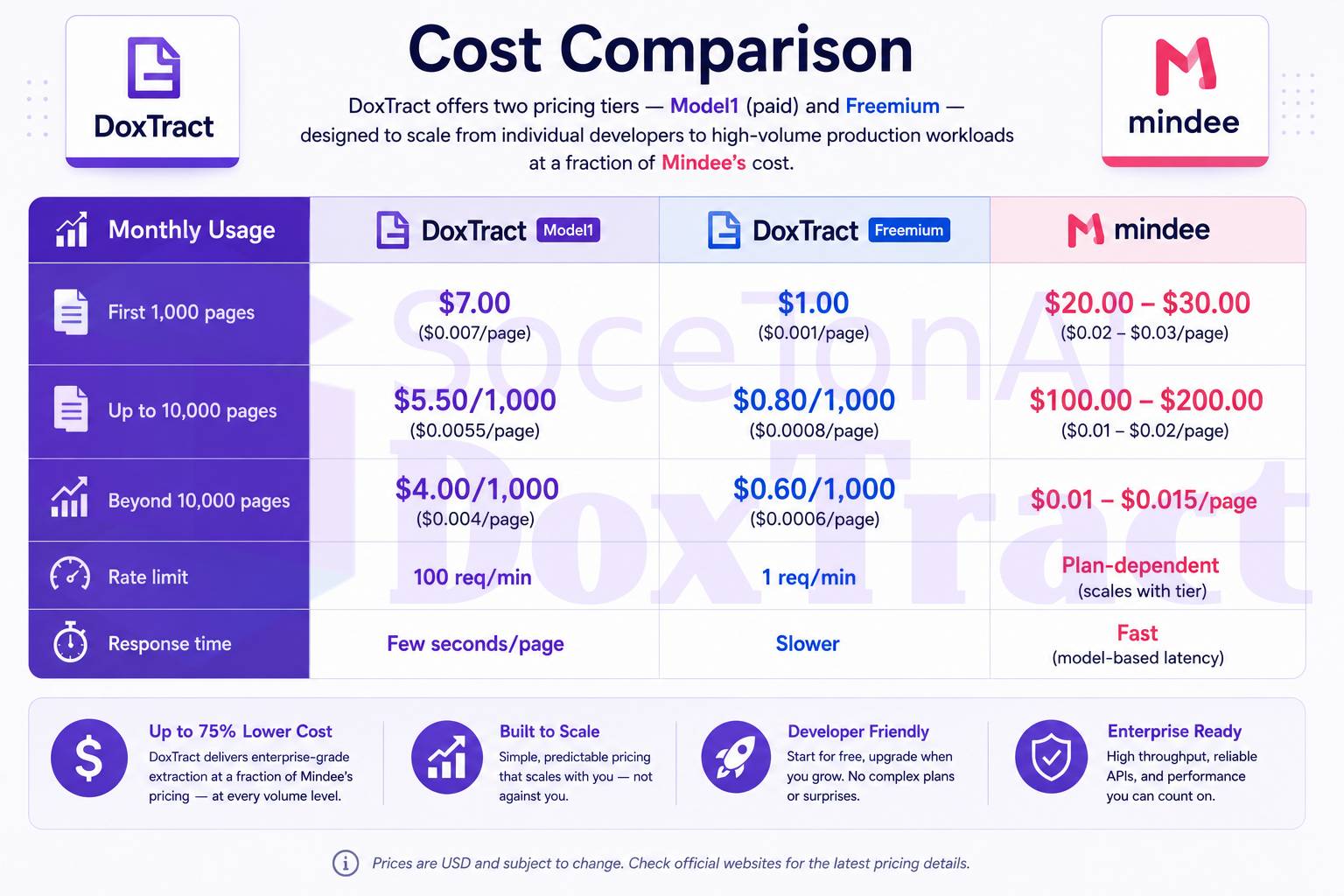
Cost Comparison
| Monthly Usage | DoxTract Model1 | DoxTract Freemium | Mindee |
|---|---|---|---|
| First 1,000 pages | $7.00/1,000 pages ($0.007/page) | $1.00/1,000 pages ($0.001/page) | $20.00–$30.00/1,000 pages ($0.02–$0.03/page) |
| Up to 10,000 pages | $5.50/1,000 pages ($0.0055/page) | $0.80/1,000 pages ($0.0008/page) | $100.00–$200.00/1,000 pages ($0.01–$0.02/page) |
| Beyond 10,000 pages | $4.00/1,000 pages ($0.004/page) | $0.60/1,000 pages ($0.0006/page) | $100.00–$150.00/1,000 pages ($0.01–$0.015/page) |
| Rate limit | 100 req/min | 1 req/min | Plan-dependent (scales with tier) |
| Response time | Fast | A few seconds/page | Fast (model-based latency) |
Mindee is genuinely competitive on price compared to the APIs and platforms like Nanonets or Parseur — its per-page rate at high volume ($0.01–$0.015/page) is close to industry-lean territory. Even so, SoceTonAI DoxTract's Model1 plan runs at roughly 2–4x lower cost per page across every volume tier, and the freemium tier extends that gap significantly further for teams that can work within its lower rate limit. Mindee's response time is a genuine strength — it's model-based and fast — so if raw latency at moderate volume is your top priority, it's worth weighing against SoceTonAI DoxTract's per-page savings directly on your own workload.
Feature Comparison
| Feature | SoceTonAI DoxTract | Mindee |
|---|---|---|
| Extraction approach | Visual template-based | Prebuilt AI models |
| Invoice and receipt extraction | ✓ | ✓ |
| Custom field configuration | Visual templates | Model/API configuration |
| Structured JSON output | ✓ | ✓ |
| REST API | ✓ | ✓ |
| Supported document layout | Best for recurring or known layouts | Strong for varied supported layouts |
| Pricing model | Fixed per-page pricing | Plan and usage-based pricing |
| Low-cost high-volume processing | Strong focus | Depends on plan and volume |
| Template control | Direct visual control | Different model-based workflow |
| Multi-language support | ✓ | ✓ |
Both platforms cover the same core AP document set and return structured JSON through a REST API, and both offer a free developer tier. The main structural difference is customization: Mindee leans on prebuilt, model-based extraction with limited template customization, while SoceTonAI DoxTract's visual template system gives you direct control over field mapping per document layout. Pricing is also structured differently — SoceTonAI DoxTract's rates are fixed per page at every tier, while Mindee's billing is usage-based and can shift with plan changes.
SoceTonAI DoxTract vs Mindee: Extraction Approach
Mindee primarily uses prebuilt AI document models. This can reduce setup time when processing supported document types with many different layouts because the model is designed to identify common fields without requiring a separate visual template for every layout.
SoceTonAI DoxTract uses a visual template-based extraction workflow. You map the fields you need once and reuse the template for future documents with the same or similar layout. This gives you more direct control over field locations and can be especially cost-effective for recurring invoices, purchase orders, forms, or other stable document formats.
The trade-off: Mindee may be easier when document layouts vary significantly, while SoceTonAI DoxTract may provide more predictable extraction behavior and lower processing costs when layouts are known and repeatable.
Accuracy: Which Is More Accurate?
There is no universal accuracy winner because the result depends on the document type and how much layouts vary.
Mindee’s prebuilt models may be more convenient for documents from many unknown vendors because the system is designed to recognize common fields across different layouts without requiring a separate template.
SoceTonAI DoxTract can perform strongly on recurring document layouts after the extraction template is configured correctly. Its template-based approach gives users direct control over which regions and fields are extracted, but a new or significantly changed layout may require a new template or adjustment.
For a meaningful comparison, process the same representative document set through both platforms and measure field-level accuracy for values such as invoice number, vendor name, invoice date, subtotal, tax, and total.
| SoceTonAI DoxTract | Mindee | |
|---|---|---|
| Accuracy | upto 99% (based on complexity) |
At a Glance
These are general positioning differences. Actual results depend on document quality, layout variation, extraction fields, and processing volume.
| Category | Better fit |
|---|---|
| Lowest cost per page | SoceTonAI DoxTract |
| Prebuilt extraction models | Mindee |
| Recurring, consistent document layouts | SoceTonAI DoxTract |
| Highly variable document layouts | Mindee |
| Visual template control | SoceTonAI DoxTract |
| Minimal setup for supported document types | Mindee |
| Predictable high-volume pricing | SoceTonAI DoxTract |
| Fast model-based extraction | Mindee |
Which One Fits Your Team
Choose Mindee if:
You want to start with prebuilt extraction models.
Your invoices or receipts come from many vendors with highly varied layouts.
You want to minimize template setup.
Fast model-based extraction is more important than achieving the lowest possible cost per page.
Choose SoceTonAI DoxTract if:
You process recurring documents with stable or predictable layouts.
You want direct visual control over extracted fields.
You need predictable per-page pricing.
You process large document volumes and want to reduce extraction costs.
You prefer creating a template once and reusing it across future documents.
Consider testing both if:
Your document layouts vary moderately.
Accuracy is more important than price.
You process a mixture of recurring and unknown document formats.
You need to compare extraction quality on specific fields.
Try It Yourself
Both platforms offer a free tier, so the fastest way to decide is to run the same batch of documents through each. SoceTonAI DoxTract's free developer tier requires no credit card and no sales call.