SoceTonAI DoxTract vs Nanonets: Pricing, Features, Use Cases, and Key Differences
Nanonets is one of the better-known no-code IDP platforms, with prebuilt invoice and receipt models and built-in workflow automation. SoceTonAI DoxTract takes a different approach — a template-driven extraction engine built to undercut both the hyperscaler APIs and platforms like Nanonets on price, without sacrificing the structured output developers need.
Here's how the two actually compare on cost, API limits, and feature coverage.
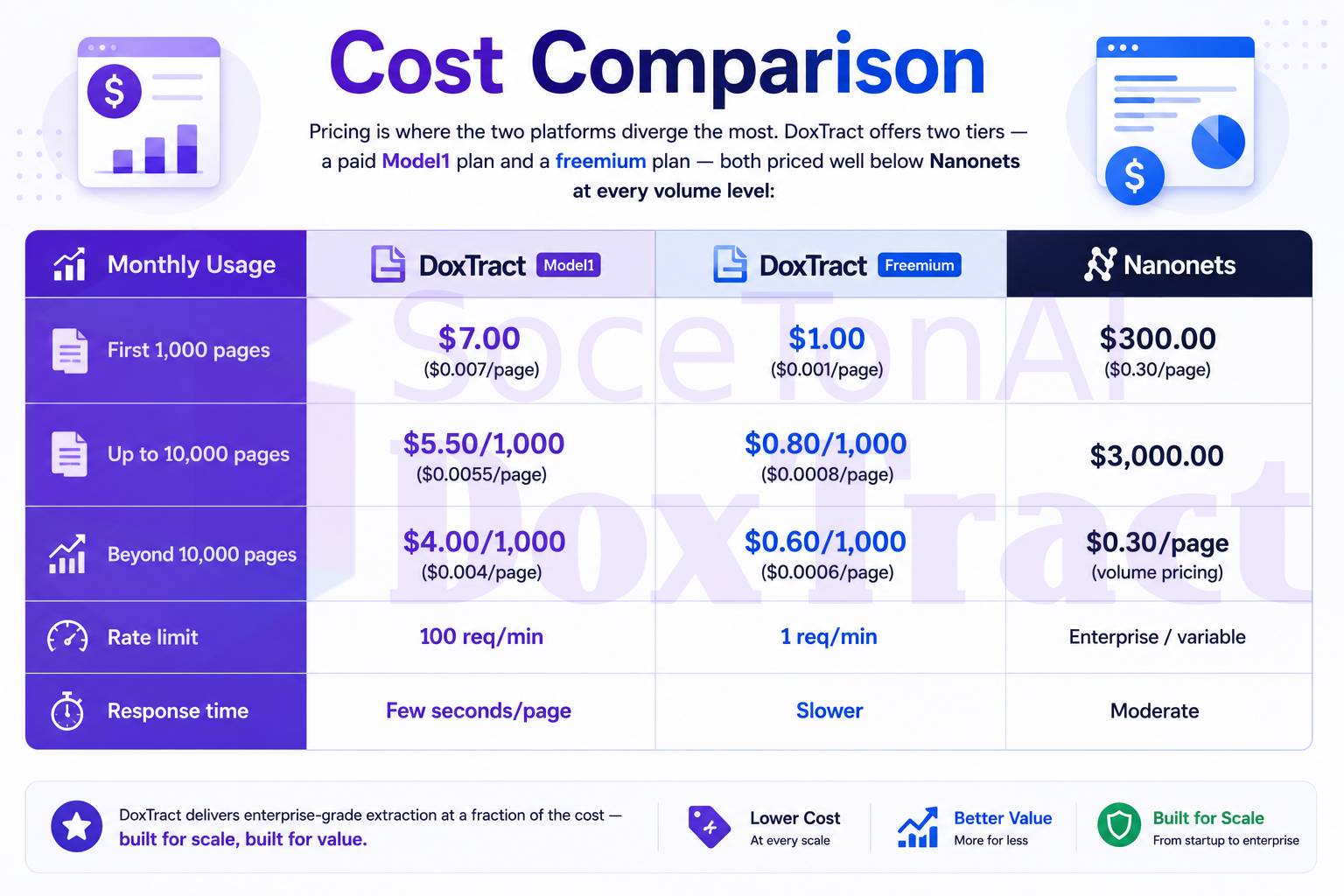
Cost Comparison
Pricing is where the two platforms diverge the most. SoceTonAI DoxTract offers two tiers — a paid Model1 plan and a freemium plan — both priced well below Nanonets at every volume level:
| Monthly Usage | DoxTract Model1 | DoxTract Freemium | Nanonets |
|---|---|---|---|
| First 1,000 pages | $7.00/1000 pages ($0.007/page) | $1.00/1,000 pages ($0.001/page) | $300.00/1,000 pages ($0.30/page) |
| Up to 10,000 pages | $5.50/1,000 pages ($0.0055/page) | $0.80/1,000 pages ($0.0008/page) | $300.00/1,000 pages ($0.30/page) |
| Beyond 10,000 pages | $4.00/1,000 pages ($0.004/page) | $0.60/1,000 pages ($0.0006/page) | $300.00/1,000 pages ($0.30/page) |
| Rate limit | 100 req/min | 1 req/min | Enterprise / variable |
| Response time | Few seconds/page | Slower | Moderate |
SoceTonAI DoxTract publishes a low per-page pricing model that can be easier for developers and smaller teams to estimate. Nanonets pricing may depend on the product, workflow, usage level, and commercial plan, so teams should request a quote or review the current pricing details before making a direct cost comparison.
Feature Comparison
Feature-for-feature, the two platforms cover the same core document types:
| Capability | SoceTonAI DoxTract | Nanonets |
|---|---|---|
| Document extraction | ✓ | ✓ |
| Invoice and receipt processing | ✓ | ✓ |
| Custom extraction fields | Visual templates | AI and workflow configuration |
| Structured JSON output | ✓ | ✓ |
| REST API | ✓ | ✓ |
| Recurring document templates | Strong fit | Supported |
| Highly varied document layouts | Template-dependent | Broader AI-model focus |
| Built-in validation and review workflows | Limited or integration-based | Broader workflow capabilities |
| End-to-end document automation | API/webhook integration | Stronger platform focus |
| Published low-cost per-page pricing | ✓ | Varies by plan or contract |
| Free developer entry | ✓ | Check current offering |
SoceTonAI DoxTract and Nanonets overlap in core document extraction capabilities, including structured data output and API-based processing. However, the products are positioned differently. SoceTonAI DoxTract focuses on template-based extraction, direct field control, and predictable low-cost processing, while Nanonets provides a broader intelligent document processing platform with additional workflow and automation capabilities.
The better choice depends on whether your priority is affordable document extraction or a more comprehensive document-processing workflow.
SoceTonAI DoxTract vs Nanonets: Extraction Approach
SoceTonAI DoxTract uses a visual template-based extraction workflow. Users define the fields they need, map those fields to relevant document regions, and reuse the template for future documents with the same or similar layouts. This approach provides direct control over the extracted fields and can be cost-effective for recurring invoices, receipts, purchase orders, and forms.
Nanonets provides a broader AI-powered document-processing platform. Its document models and workflow tools are designed to support extraction across different document types and layouts, with additional capabilities for validation, review, and business-process automation.
The trade-off is that SoceTonAI DoxTract is more focused on straightforward, configurable, low-cost extraction, while Nanonets may be more suitable for organizations that need a wider document-processing workflow.
Accuracy and Document Variation
There is no universal accuracy winner because extraction results depend on document quality, layout variation, the fields being extracted, and how the extraction workflow is configured.
SoceTonAI DoxTract can be a strong fit for recurring document layouts because users can configure templates around known fields and document structures. Nanonets may be more convenient when documents vary significantly and a broader AI-based extraction and review workflow is needed.
The best way to compare accuracy is to process the same representative document set through both platforms and measure field-level accuracy for important values such as vendor name, invoice number, date, line items, tax, and total.
Quick Comparison
SoceTonAI DoxTract may be the better fit when low and predictable extraction costs are the priority. Nanonets may be a better fit when a team needs a broader document automation platform with workflow capabilities beyond data extraction.
| Category | SoceTonAI DoxTract | Nanonets |
|---|---|---|
| Primary focus | Low-cost template-based document extraction | Broader intelligent document processing and workflow automation |
| Extraction approach | Visual templates and configurable fields | AI models, document extraction, and workflow tools |
| Best fit | Recurring or predictable document layouts | Complex document-processing workflows |
| API access | ✓ | ✓ |
| Structured data output | ✓ | ✓ |
| Visual extraction configuration | ✓ | ✓ |
| Workflow automation | API/webhook-based integration | Broader built-in workflow capabilities |
| Pricing approach | Published per-page pricing | Plan, usage, or contract-based pricing |
| Lower-cost high-volume extraction | Strong focus | Depends on the selected product and agreement |
Which One Fits Your Team
Choose Nanonets if:
You need a broader intelligent document-processing platform.
Your workflow includes document validation, human review, approvals, or downstream automation.
You process many different document layouts.
You prefer a more comprehensive no-code workflow.
Your organization can support a larger platform budget or enterprise procurement process.
Choose SoceTonAI DoxTract if:
You primarily need document data extraction rather than a full workflow platform.
Your documents have recurring, known, or reasonably predictable layouts.
You want direct visual control over extraction fields.
You need a REST API for integration into your own application.
Low and predictable per-page processing costs are important.
You want to start with a free developer tier.
Test both if:
Accuracy is the most important selection factor.
Your documents contain many different layouts.
You need both extraction and workflow automation.
You are processing enough volume that pricing differences could materially affect your costs.
Try It Yourself
The best way to compare two OCR platforms is on your own documents, not a vendor's demo. SoceTonAI DoxTract's free developer tier requires no credit card and no sales call.