SoceTonAI DoxTract vs Parseur: Pricing, Features, and Performance Compared
SoceTonAI DoxTract and Parseur both automate document data extraction, but they are designed around somewhat different workflows. Parseur is known for parsing documents and emails and sending extracted data to downstream applications, while SoceTonAI DoxTract focuses on template-based document extraction through a visual builder and REST API.
The best choice depends on your document intake process, how much your layouts vary, the integrations you need, and how many pages you process each month. This comparison looks at pricing, extraction methods, automation, API access, and the use cases where each platform may be a better fit.
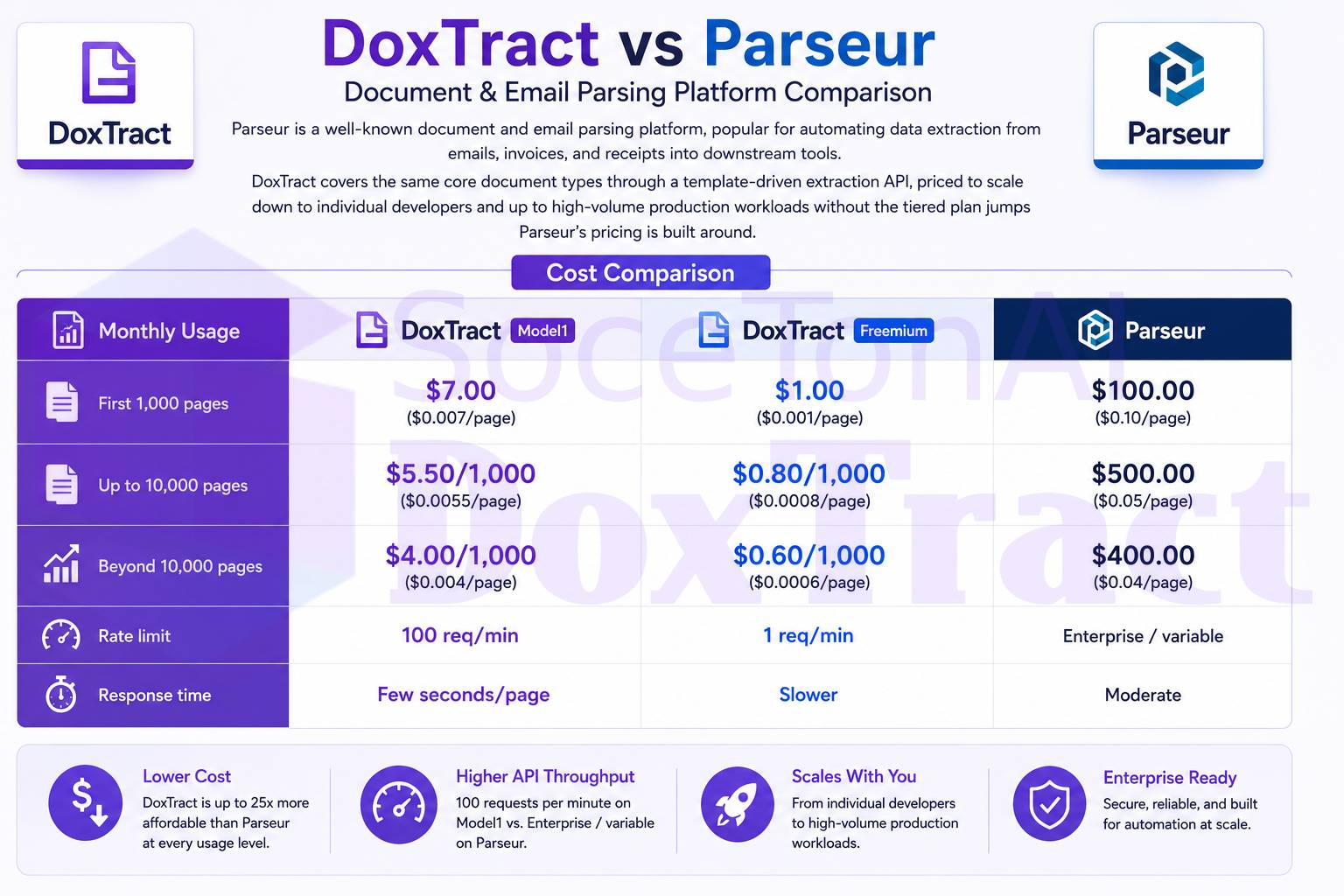
Cost Comparison
| Monthly Usage | DoxTract Model1 | DoxTract Freemium | Parseur |
|---|---|---|---|
| First 1,000 pages | $7.00/1,000 pages ($0.007/page) | $1.00/1,000 pages ($0.001/page) | $100.00/1,000 pages ($0.10/page) |
| Up to 10,000 pages | $5.50/1,000 pages ($0.0055/page) | $0.80/1,000 pages ($0.0008/page) | $500.00/1,000 pages ($0.05/page) |
| Beyond 10,000 pages | $4.00/1,000 pages ($0.004/page) | $0.60/1,000 pages ($0.0006/page) | $400.00/1,000 pages ($0.04/page) |
| Rate limit | 100 req/min | 1 req/min | Enterprise / variable |
| Response time | Few seconds/page | Slower | Moderate |
SoceTonAI DoxTract uses a lower fixed per-page pricing model, while Parseur's costs are structured around subscription plans and usage allowances. At the usage levels shown in the table, SoceTonAI DoxTract has a lower estimated processing cost. However, the total cost depends on the Parseur plan, included credits, document volume, and any additional workflow requirements.
SoceTonAI DoxTract's paid Model1 tier supports up to 100 API requests per minute. Parseur's available processing capacity depends on the selected plan and workflow configuration, so teams with high-throughput requirements should confirm the limits that apply to their account.
Feature Comparison
| Feature | SoceTonAI DoxTract | Parseur |
|---|---|---|
| Invoice and receipt extraction | ✓ | ✓ |
| Purchase order extraction | ✓ | ✓ |
| Visual extraction templates | ✓ | ✓ |
| Structured JSON output | ✓ | ✓ |
| REST API | ✓ | ✓ |
| Email-based document intake | API workflow | Built-in workflow focus |
| Custom extraction rules | Template-based | Template-based |
| Workflow integrations | API and webhooks | Built-in integrations and automation |
| Pricing model | Usage-based per page | Subscription plans with usage allowances |
| Primary strength | Low-cost document extraction | Document and email workflow automation |
Feature coverage between the two platforms is close — both handle invoices, receipts, purchase orders, delivery notes, and email-based intake, and both return structured JSON through a REST API. Parseur also offers a free developer tier, so the real differentiators come down to pricing structure and scale: SoceTonAI DoxTract's pricing is fixed and usage-based at every volume, while Parseur's shifts across quota-based tiers as you grow, and SoceTonAI DoxTract is built with higher-throughput real-time batch processing as the default rather than the exception.
SoceTonAI DoxTract vs Parseur: How Data Extraction Works
SoceTonAI DoxTract uses a visual template-based workflow. You define the fields you want to extract, map them to the relevant areas of a document, and reuse the template for future documents with the same or similar layouts. This approach can work well for recurring invoices, receipts, purchase orders, and other documents with predictable formats.
Parseur also provides template-based parsing but places greater emphasis on document and email automation workflows. Its broader workflow may be useful when documents are received through email and extracted data needs to be sent to connected applications without building the entire workflow through an API.
The practical difference is that SoceTonAI DoxTract is more focused on affordable document extraction and API-based processing, while Parseur offers a broader parsing and automation workflow around document intake.
Accuracy and Document Layouts
There is no universal accuracy winner because extraction quality depends on document quality, layout variation, field complexity, and the extraction configuration.
SoceTonAI DoxTract can work well when document layouts are recurring and the extraction template is configured for those layouts. Parseur may be convenient when its parsing workflow and templates match the document types being processed.
Before selecting either platform, test a representative set of documents and measure field-level accuracy for important values such as invoice number, vendor name, date, tax, subtotal, and total.
Quick Comparison
Neither platform is automatically better for every workflow. SoceTonAI DoxTract may be more attractive when predictable per-page costs and API-based processing are priorities, while Parseur may be more convenient when documents arrive through email and need to flow into connected business tools.
| Category | SoceTonAI DoxTract | Parseur |
|---|---|---|
| Core approach | Template-based document extraction | Document and email parsing |
| Best for | Recurring document layouts and API workflows | Email-driven document workflows and automation |
| Visual extraction templates | ✓ | ✓ |
| Email inbox workflow | More API-focused | Stronger built-in workflow |
| REST API | ✓ | ✓ |
| Downstream integrations | API/webhook-based | Broader built-in automation focus |
| Pricing approach | Per-page usage pricing | Plan and quota-based pricing |
| High-volume cost focus | Strong | Depends on plan and usage |
Which One Fits Your Team
Choose Parseur if:
Documents primarily arrive through email.
You want built-in document intake and workflow automation.
You need integrations with downstream business tools.
You prefer a broader no-code parsing workflow.
Your expected document volume fits comfortably within a selected plan.
Choose SoceTonAI DoxTract if:
You process recurring documents with known or predictable layouts.
You want lower and more predictable per-page processing costs.
You need a REST API for integrating extraction into your own application.
You process large document volumes and want to avoid major pricing jumps between plans.
You want direct control over extraction fields through visual templates.
Test both if:
Your workflow depends heavily on email automation but processing cost is also important.
You have many different document layouts.
Accuracy on specific fields is more important than the platform's advertised features.
You need to evaluate extraction quality using your own documents.
Try It Yourself
The most reliable comparison is running your own documents through both platforms. SoceTonAI DoxTract's free developer tier requires no credit card and no sales call.