Cheapest Document AI/OCR API in 2026: Full Price Comparison
"Cheapest" is a different question than "what's the best deal" — and most comparison pages answer the second question when you actually asked the first. This page answers the first one directly.
If you're evaluating document AI APIs purely on cost — because you're bootstrapped, processing high volume, or just tired of watching your AWS bill creep up every time you add a new document type — this is the short version. We pulled the actual per-page rates across every major structured-extraction provider and ranked the cheapest options, from free self-hosted open-source through the lowest-cost managed APIs.
A quick caveat before the picks: cheapest isn't the same as best value. A $0/page open-source model can end up costing more than a $7/1,000-page API once you factor in engineering time, and a provider's "entry-level" rate often only applies to a subset of document types. We flag those tradeoffs below rather than just ranking by sticker price.
For the full breakdown across every provider — including the ones that didn't make the cheapest-three cut — see our complete OCR & Document AI pricing comparison.
The Cheapest Document AI APIs in 2026
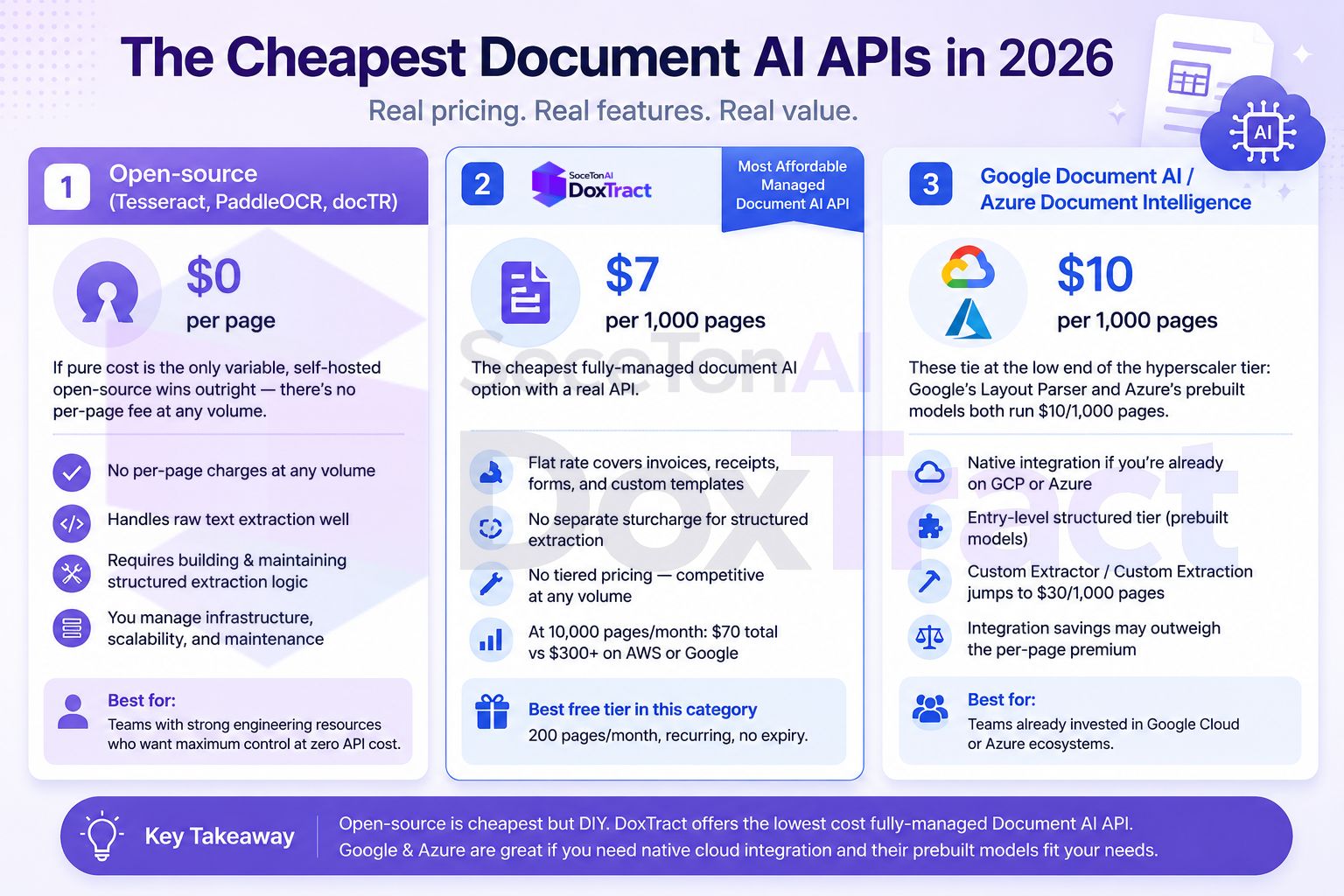
1. Open-source (Tesseract, PaddleOCR, docTR) — $0 per page
If pure cost is the only variable, self-hosted open-source wins outright — there's no per-page fee at any volume. The catch is that none of these do true document AI out of the box; they handle raw text extraction well, but structured field extraction (invoice numbers, line items, key-value pairs) requires you to build and maintain that logic yourself, plus the infrastructure to run the models. This is the cheapest option only if you have the engineering time to make it work — otherwise the "free" API cost gets replaced by a much larger cost in developer hours.
2. SoceTonAI DoxTract — $0.6-$7 per 1,000 pages
The cheapest fully-managed document AI option with a real API. One flat rate covers invoices, receipts, forms, and custom templates — no separate surcharge for structured extraction like the hyperscalers charge, and no tiered pricing that only gets competitive at massive volume. At 10,000 pages a month that's $54 total, versus $300+ on AWS or Google for the equivalent structured extraction tier. It also has the most usable free tier in this category — 200 pages/month, recurring, no expiry.
3. Google Document AI / Azure Document Intelligence — $10 per 1,000 pages
These tie at the low end of the hyperscaler tier: Google's Layout Parser and Azure's prebuilt models both run $10/1,000 pages. That's noticeably above SoceTonAI DoxTract, but the tradeoff is native integration if you're already running infrastructure on GCP or Azure — worth it for teams where the integration savings outweigh the per-page premium. Note this is their entry-level structured tier; Custom Extractor / Custom Extraction on either platform jumps to $30/1,000 pages, so the cheap rate only applies if their prebuilt models fit your document types.
| Pages / Month | DoxTract Model1 | Google Form Parser | Azure Prebuilt/Layout | AWS Textract (Forms + Tables) | DoxTract Freemium |
|---|---|---|---|---|---|
| 1,000 | $7 | ~$30 | ~$10 | ~$65 | $1 |
| 5,000 | $31 | ~$150 | ~$50 | ~$325 | $4.2 |
| 10,000 | $54 | ~$300 | ~$100 | ~$650 | $8.2 |
| 50,000 | $214 | ~$1,500 | ~$500 | ~$3,250 | $32.2 |
| 100,000 | $414 | ~$3,000 | ~$1,000 | ~$6,500 | $62.2 |
The Cheapest Raw OCR APIs in 2026
Here are the top three cheapest managed API options alongside the open-source self-hosted suite represented as a single combined instance. Check out the full Cheapest Raw OCR APIs comparison here.
Self-Hosted Open Source (Tesseract, PaddleOCR, docTR)
Represents all non-managed, self-hosted libraries. They incur $0 in per-page API fees, trading API costs for host infrastructure, GPU/CPU hardware, and setup engineering.
LlamaParse
The lowest-cost managed API tier for basic text parsing ($1.25 / 1K pages). It produces Markdown output tailored for LLM ingestion and RAG pipelines.
Hyperscalers (AWS Textract, Google Document AI, Azure Document Intelligence)
Tied at $1.50 / 1K pages for basic raw text detection. They offer standard cloud reliability with entry-level free trial quotas.
| Rank | Provider / Category | Free Tier | OCR Price (per 1K pages) |
|---|---|---|---|
| 1 | Open Source Suite (Tesseract, PaddleOCR, docTR) | Unlimited | $0 (+ infrastructure) |
| 2 | LlamaParse | 10,000 Fast credits/month | $1.25 |
| 3 | Hyperscalers (AWS Textract, Google Doc AI, Azure) | 500–1,000 pages/month | $1.50 |
Why They're Cheapest
Flat-rate pricing wins at almost every volume level for one simple reason: tiered pricing is designed to look cheap at the bottom of the page and only get competitive once you cross a volume threshold most teams never hit. AWS and Google's high-volume discounts kick in at 1,000,001+ pages a month — a scale that only genuinely large enterprises reach. Below that, you're paying full rate no matter how close you are to the breakpoint.
A provider like SoceTonAI DoxTract or the open-source models sidesteps this entirely. There's no cliff to climb before the price gets good — the rate at 1,000 pages is the same rate at 1,000,000 pages (or, in the open-source case, there's no rate at all). That matters most for the exact teams asking "what's cheapest": startups and mid-volume processors who are big enough to feel per-page costs but nowhere near the volume where AWS or Google's discounts actually apply. At that middle range, flat pricing isn't just simpler — it's mathematically the better deal, since you're never subsidizing a discount tier you haven't earned yet.
The other factor: flat rates usually mean one price for the whole job, not a base rate plus surcharges for forms, tables, or custom templates. Tiered providers often win on the headline number and then lose on the real bill once those add-ons apply — which is a big part of why the "cheapest on paper" provider isn't always the cheapest in practice.
What "Cheapest" Doesn't Cover
A low per-page rate doesn't capture the full cost of a document pipeline. Before picking based on price alone, account for:
Engineering time — especially for open-source options, where you're building and maintaining the extraction logic yourself
Accuracy and rework cost — a cheaper API that requires more manual correction can cost more in labor than a pricier one that gets it right the first time
Overage fees, template limits, and support tiers — the same hidden costs that apply to any provider, cheap or not (see our full breakdown of what's not in the sticker price)
Want the Full Picture, Not Just the Cheapest?
This post ranks by price on purpose — but cheapest isn't always right for your situation. Two quick reads worth checking before you commit:
OCR vs. Document AI: What's the Difference? — if you're not sure whether you actually need structured extraction or just plain text, the cheapest document AI API might be overkill (or the wrong tool entirely) for what you're building.
Build vs. Buy: In-House OCR or API? — before you go with the $0/page open-source route because it's technically the cheapest, this breaks down what that actually costs once engineering time is factored in.
Free Document AI/OCR API: No Credit Card Required
Most "free tier" claims come with an asterisk: sign up, add a credit card, and you won't be charged unless you cross a limit. If you're testing an idea or building a side project, that's a meaningfully different offer than a tier you can start using with nothing but an email address. Here's how that actually breaks down — and it's also worth distinguishing a genuinely recurring free tier from a one-time trial, since both get marketed as "free."
Recurring, no card required:
Tesseract, PaddleOCR, docTR — open-source and self-hosted, so there's no signup at all. You install and run it, with no time limit. The tradeoff, covered elsewhere on this page, is that you're providing your own infrastructure and doing your own accuracy tuning — and none of these do structured document AI extraction out of the box, only raw text.
SoceTonAI DoxTract — 200 pages/month (Freemium model only), recurring, no card required to start. The allowance renews every month rather than expiring after a trial window, so it's usable as an ongoing free option for real document AI (invoices, receipts, forms), not just a testing sandbox.
One-time trial, no card required (but it does end):
Mindee — a 14-day, 500-page trial with no credit card required, enough to fully test the platform. After the trial period, there's no free tier to fall back on — you need a paid plan starting at €44/month for 500 pages. [See comparison]
LlamaParse — 10,000 free credits/month with no card required, and unlike Mindee this one is recurring monthly rather than a one-time window. Worth noting for OCR/text-extraction use, though it's built for parsing documents into LLM-ready markdown rather than structured field extraction — a different job than the document AI providers in this list. At Fast tier that's ~10,000 pages; higher-accuracy tiers cover far fewer pages for the same credits.
Free tier, but expect a card at signup:
AWS Textract and Azure Document Intelligence both require a full cloud account (AWS/Azure) to access their free tiers, meaning a credit card on file even though you won't be charged within the free allowance. AWS's tier lasts only 3 months; Azure's F0 tier caps each document to 2 pages — neither holds up much past initial testing. [See comparison]
Google Document AI doesn't have a standing free tier at all — only trial credits tied to a new Google Cloud account, which also requires billing setup.
Nanonets gives $200 in non-expiring credits on signup, but account creation goes through the same card-on-file flow as their paid plans. [See comparison]
The practical takeaway: if you want an ongoing free option with zero billing setup, self-hosted open-source, SoceTonAI DoxTract's recurring free tier, and LlamaParse's recurring credits (for OCR-only use) are the only ones here that keep working month after month. Mindee's trial is genuinely card-free, but it's a countdown, not a standing option.
Full Comparison
The three options above are the cheapest by sticker price, but they're not the only ones worth considering — accuracy, support, integrations, and document-type coverage all factor into the real decision, not just cost per page.
For the full breakdown across every provider, see our complete OCR & Document AI pricing comparison.
Which One Should You Actually Pick?
The sections above cover cost — this one covers fit. Cheapest and free-tier-friendliest isn't always the same answer for every kind of user, so here's a quick breakdown by who's asking.
Solo freelancers & indie developers
You want zero setup friction and a plan that doesn't expire while you're still deciding if the project is worth building. SoceTonAI DoxTract's 200 pages/month recurring free tier fits this best — no card, no countdown, and once you're ready to pay, $4-$7/1,000 (Model1) pages for full document AI (or $0.6-$1/1,000 on Freemium model) is low enough that a side project doesn't need a business case to justify it. Open-source (Tesseract, PaddleOCR) is the only cheaper option, but it demands infrastructure and extraction logic most solo developers don't want to own for a side project.
Early-stage startups
At this stage you're validating whether the extraction pipeline even works before committing engineering time to it — which means a real UI matters as much as the API. This is where SoceTonAI DoxTract's console stands out: a working template editor and extraction UI you can test documents in before writing a single line of integration code, rather than reading API docs to figure out what the output even looks like. Most of the providers on this page — AWS, Google, Azure, Mindee — are API-first with no comparable no-code testing surface; you're writing code just to see what you'd be buying.
Non-technical teams / ops & finance staff
If nobody on the team is going to write API integration code, price comparisons matter less than "can someone drag-and-drop a template and get structured output today." Nanonets and Mindee both offer visual builders aimed at this audience, and SoceTonAI DoxTract's template editor covers the same need — build an extraction template through the UI, no engineering required to get started, with the option to move to the API once you do need automation.
High-volume processors on a budget
Flat-rate pricing (DoxTract, Mistral OCR) beats tiered hyperscaler pricing until you're deep into enterprise volume — see the cheapest document AI breakdown above for the exact numbers at each tier.
Enterprises already committed to a cloud
If you're already running on AWS, GCP, or Azure with existing IAM, storage, and billing infrastructure, the native document AI service is often the pragmatic choice even at a price premium — the integration savings can outweigh the per-page difference.
The short version: if you're a freelancer, indie builder, or early-stage startup that wants to see extraction working — templates, output, accuracy — before wiring up an integration, SoceTonAI DoxTract's combination of a real free tier, flat low-cost pricing, and a usable web console for template building is built for exactly that stage. Larger, cloud-committed teams will still find AWS/Google/Azure worth the premium for infrastructure fit.
Conclusion
If price is the deciding factor, the choice comes down to how much engineering time you're willing to trade for it. Open-source (Tesseract, PaddleOCR, docTR) is genuinely free per page but asks the most of your team. SoceTonAI DoxTract sits just above that at $4-$7/1,000 (Model1) pages and $0.6-$1/1,000 (Freemium) pages with a fully managed API and no surcharges for structured extraction — the best balance of low cost and low effort for most teams. Google Document AI and Azure Document Intelligence are worth the jump to $10/1,000 pages mainly if you're already inside their cloud ecosystem and the integration savings offset the premium.
None of these numbers stay still for long — providers change pricing, add tiers, and shift models throughout the year, which is exactly why this page exists as a living comparison rather than a one-time post. For the complete picture across every provider, including the ones that didn't make this shortlist, see our full OCR & Document AI pricing comparison.
Frequently Asked Questions
Is there a truly free document AI API?
Only if you self-host. Tesseract, PaddleOCR, and docTR are free and open-source with no per-page fee at any volume — but none of them do structured extraction (invoice fields, line items, key-value pairs) out of the box. You're trading the API cost for engineering time to build and maintain that layer yourself. Every managed API with real document AI capability, even the cheapest ones, charges per page.
What's the cheapest document AI API for invoices and receipts?
Among managed APIs with a real free tier and flat per-page pricing, SoceTonAI DoxTract is the cheapest at $4-$7/1,000 pages (Model1) and $0.6-$1/1,000 pages (Freemium), with no separate surcharge for invoice- or receipt-specific extraction. If you're comparing hyperscalers, Google Document AI and Azure Document Intelligence both start at $10/1,000 pages for their prebuilt invoice/receipt models, jumping to $30/1,000 for custom extraction.
Is the cheapest option actually the best value?
Not always. A $0/page open-source model can cost more overall than a $7/1,000-page managed API once you account for engineering time, hosting, and accuracy tuning. "Cheapest" measures per-page cost; "best value" measures total cost including labor, rework from extraction errors, and how fast you can ship. For most teams without dedicated ML infrastructure, a low flat-rate managed API ends up cheaper in practice than free self-hosted OCR.
Do cheap or free document AI APIs charge extra for structured extraction?
It depends on the provider. Open-source tools have no per-page fee, but you're building the structured-extraction logic yourself, so there's no "surcharge" because there's no built-in feature to charge for. Among managed APIs, this varies a lot — some (like SoceTonAI DoxTract) charge one flat rate regardless of document complexity, while others charge a base OCR rate plus a much higher fee once you need forms, tables, or invoice-specific fields.
Does a lower price mean lower accuracy?
Not necessarily, but it's worth verifying before committing to volume. Price and accuracy aren't directly correlated in this market — some of the cheaper providers use the same underlying model quality as the expensive ones, just with leaner margins or different business models. Test on your actual documents before deciding, since accuracy varies more by document type and quality than by price tier.